I am a media artist and researcher. I make installations, games, real-time simulations and AI characters, mostly for people who are not specialists. One thing runs through all of it: the work lets people handle something they cannot reach on their own. A person from the past survives only in records. A feeling cannot be held. Dark matter cannot be seen. In each case I build a system that stands in for it, and because the person using the system cannot check it against the real thing, much of my research is about its limits: what it is allowed to say, where it stays true to the record or the science, and how the person learns its rules by using it.
The work sits in three areas, AI and archives, embodiment and simulation, and they overlap. Drag the circles to see which projects they share.
- AI and archives
- Embodiment
- Simulation
- Memory Space: Chinatown ARAI characters who meet visitors in an AR reconstruction of the Chinatown demolished for Union Station.
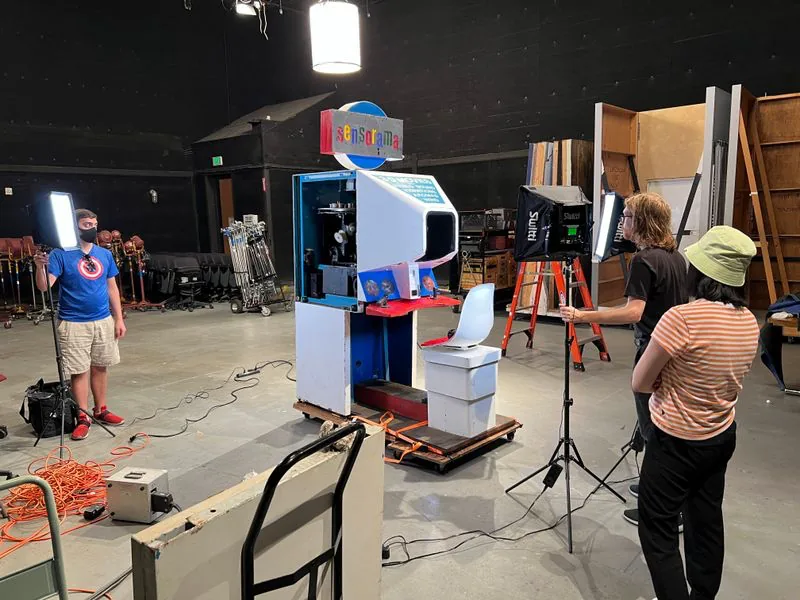
- Immersive ArchiveAn AI character inside a VR reconstruction of the Sensorama, answering from Morton Heilig's papers.
- Stratford WonderlandA VR game about a district of east London, built from archives and interviews with residents.
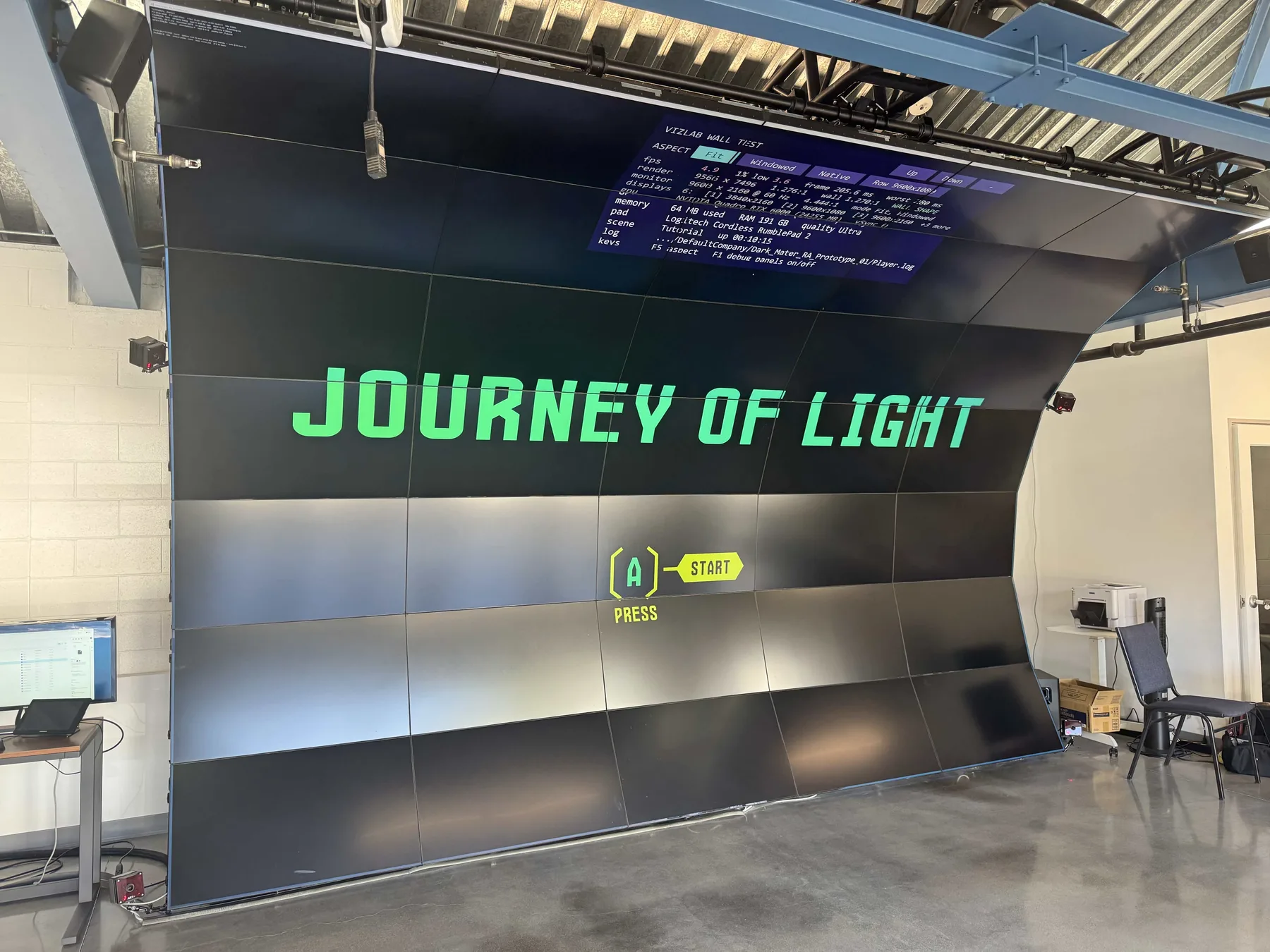
- Dark Matter Interactive ExperienceA real-time experience for a large display at Carnegie Science Observatories.
- Sophie's Night Sky AdventureA children's picture book turned into a gesture game about constellations.
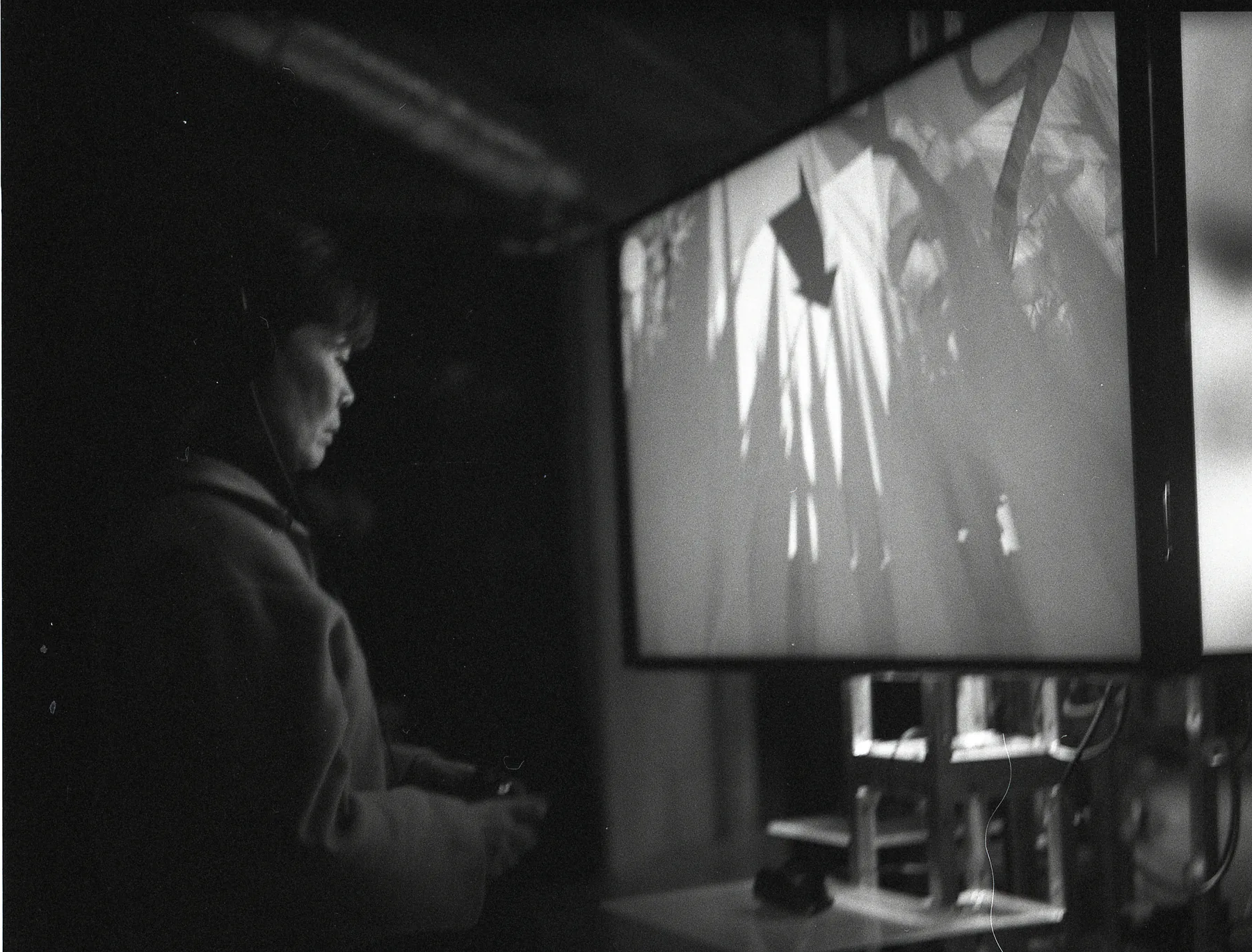
- EmotionFour emotions as four control schemes. Arebyte Gallery, London.
- Quattuor ScapesFour temperaments as four terrains. Arebyte Gallery, London.
- Emotional WeatherA real-time landscape where the viewer sets the weather.
- Verlet VoyageA physics game for children on a soft-body engine I wrote.
The two works in the middle, the Immersive Archive and the Dark Matter Interactive Experience, are the ones I spend most of my time on. In both, the system stands in for something the visitor cannot check for themselves, Heilig's papers or dark matter, so it has to stay true to its source, and the visitor meets it through the body: a conversation inside a VR reconstruction, a gamepad in front of a curved wall. The gallery works are where this began, with feelings and temperaments as the thing the visitor handles.
◆ AI and archives
AI personas and the records behind them.
Here what is out of reach is a person or a place that survives only in records. This area is about giving that material a voice with AI. Its focus is the persona, meaning how historical people and places are turned into characters that can hold a conversation, and the database underneath it: papers and other records made into structured, searchable data with their sources attached. Much of the design is about limits: what the character may say, how it handles gaps in the record, and how consent and data rules shape what gets built.
Representative projects
- 2026Immersive ArchiveAn AI persona built from Morton Heilig's papers.
- 2026Memory Space: Chinatown ARThe conversational AI and database behind the project's characters.
◆ Embodiment
Embodiment and installation.
This area is about how the person meets the system. It covers installations and games where the body is the interface, and in the gallery works the thing being handled is itself out of reach: a feeling, or a temperament. I design the controls, the physical setup and the room together, so that how a visitor moves, or holds still, becomes part of what the work says. It ranges from gallery installations and gesture pieces to VR and a large-format display.
Representative projects
- 2024 to 2025Body, Mind and SoulEmotional Weather, Emotion and Quattuor Scapes. The last two were shown at Arebyte Gallery, London.
- 2026Sophie's Night Sky AdventureA gesture game about constellations, made for exhibition.
◆ Simulation
Real-time systems and simulation.
For me a real-time simulation is a way to let people handle something they cannot see or touch directly, such as physical forces, weather or dark matter. Because it answers every input straight away, people learn its rules by trying things. Where I can, I write the systems myself, from a soft-body physics solver to procedurally generated universes, so the behaviour can be tuned to what the work needs to show. When the subject is scientific, the model also has to stay true to the science, so the design is worked out with the scientists.
Representative projects
- 2026Dark Matter Interactive ExperienceA simulation of how dark matter shapes intergalactic gas.
- 2025Verlet VoyageA physics game for children on a soft-body solver I wrote.
◆ Research context
Fields I draw on.
- Media archaeologyReading an old device together with the ideas written around it. The Immersive Archive rebuilds the Sensorama, and Mort answers from the Idea Books and lectures in which Heilig worked those ideas out.
- Archival studiesProvenance, and the difference between a record that is authentic and one that is reliable. Every passage in Mort's knowledge base keeps its item number, and an answer that repeats a mistake in Heilig's own lecture is graded as a problem of the source, not of Mort.
- Contestable AIThe idea that people should be able to question what an AI system tells them. Mort cites the item behind each answer and says when the archive is silent, so a visitor can check an answer against the page it came from.
- Embodied interactionMeaning made through how people act, not only through what is on screen. In Emotion each feeling is a way of moving, and in Sophie's Night Sky Adventure the hand is the controller.
◆ How I work
Methods.
Making
- Research through design
- Iterative prototyping
- Custom real-time systems
Archives and data
- Archival research
- Transcription and metadata
- Retrieval evaluation
People
- Playtesting
- Observation and interviews
- Questionnaires and in-game metrics
- Expert review
◆ Who did what
My part in each collaborative work.
- Immersive ArchiveTeam project at USC MEML. Mine: the retrieval pipeline, the first character prompt, transcription and metadata, and the validation framework. Shared: refining the persona with the other researchers. Teammates: the voice, the avatar and the VR reconstruction.
- Memory Space: Chinatown ARLab project with partners. Mine: the conversational AI behind the characters, the project database and its governance, and the tools that keep the project's assets consistent across platforms. Not mine: the AR experience.
- Dark Matter Interactive ExperienceAnnenberg Fellow on LARC. Mine: the design of the whole experience as an interactive game, procedural generation, the simulation and its visualisation, playtesting, and coordination between scientists and designers. The scientists: the cosmological models and data, and review of every visual decision.
- EmotionSolo. Design, programming, the wall text and the installation.
- Quattuor ScapesArtist and technical director, with Uliana Sado, Tim Sang and Nika Varga. Wall text and installation mine.
- Stratford WonderlandGame design, programming and team lead, with Uliana Sado, Nika Varga and Tim Sang.
- Emotional Weather, Verlet VoyageSolo: design, programming and the writing.
◆ Next
Where the work is going.
The three areas are coming together. Mort is being built as a character in VR with a voice, and the dark matter experience is heading for a public display, so in both the AI or the simulation will be met through the body, in a room, by people who did not come to study it. What I want to work on next sits there: AI characters and simulations in embodied, real-time settings, and how to keep them true to their source while someone is playing with them.
The other thread is checking. The evaluation built for Mort, which traces each failure back to the page, the transcription or the model, is the kind of method I want to carry to other characters built from records, starting with the ones in Memory Space: Chinatown AR.
◆ Record
Outputs so far.
- In preparationFaithful to the Record, Faithful to the Person? Archive and Character Fidelity in a Conversational Agent of Morton Heilig (Immersive Archive).
- In preparationA paper on translating cosmological simulation into a public interactive experience (LARC).
- Oct 2026Dark Matter Interactive Experience, alpha build on the VizLab display wall, for the Carnegie Science Observatories display, Pasadena.
- May 2026First playtest of the Dark Matter Interactive Experience, 20 participants, two builds compared.
- 2025Quattuor Scapes, group exhibition, Arebyte Gallery, London.
- 2025Verlet Voyage, UCL BA Media Degree Show. Practice-based dissertation.
- Mar 2024Emotion, in Algorithmic Unconscious, Arebyte Gallery, London. Part of Arebyte's programme The Body, The Mind, The Soul, Arts Council England funded.