The project
Most of the matter in the universe cannot be seen. This project maps it through the light of distant quasars.
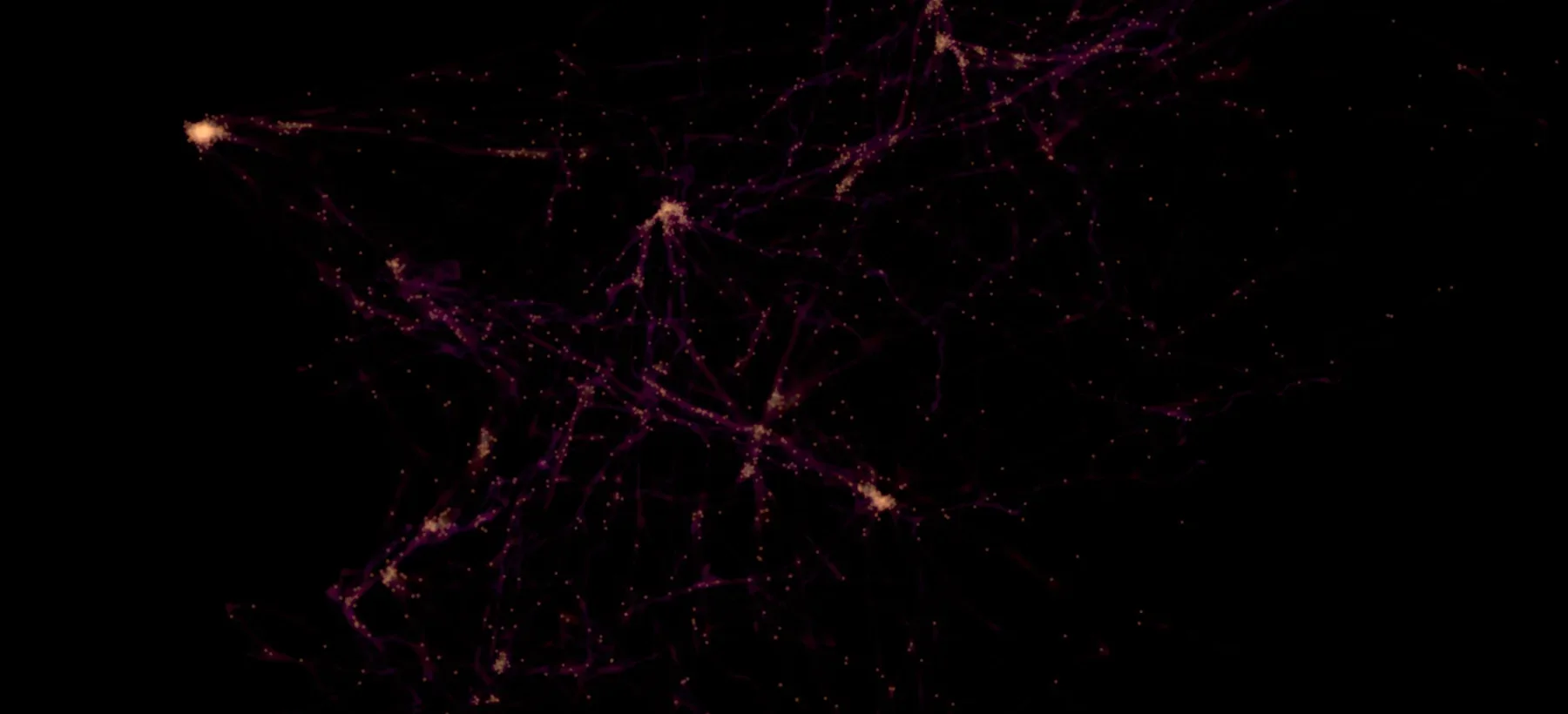
LARC, the Lyman-Alpha Forest Research Collaboration, is a research hub of USC, UC Riverside and Carnegie Science Observatories, led by Vera Gluscevic at USC and Simeon Bird at UC Riverside. The John Templeton Foundation funds it with a $4 million grant, from December 2025 to December 2028, under the title Growing a Universe from Quantum Scales: Discovery at the Intersection of Cosmology, Epistemology and Interactive Visual Media. The hub simulates how structure formed in the early universe and works toward observational tests of dark matter. It also uses interactive visual media to bring these ideas to the public.
The observations use the Lyman-alpha forest, the absorption lines that hydrogen between galaxies leaves in the light of distant quasars, to trace the gas and the dark matter it gathers around. This experience is that interactive visual media: a stereoscopic 3D simulation for Carnegie's large display in Pasadena. A visitor travels as light that left a quasar twelve billion years ago and watches the hydrogen it passes through write the forest into its spectrum.
Contribution
How to make an invisible cause understandable through play, for a public with no background in it?
Recruiting and directing a team of four research assistants, and running the project meetings with the scientists.
Design↓The journey, the order ideas arrive in, the voice-over, the simplified controls.
Technical art↓Procedural universes, gas and the cosmic web in real time, the spectrum system, the curved stereoscopic wall.
Playtests↓Questionnaires, in-game metrics and interviews, and the redesign that followed.
I was responsible for the simulation's development and design, under Prof. Sean Bouchard and Prof. Martzi Campos at the USC School of Cinematic Arts. The science, and the review of every visual decision, comes from the LARC scientists.
Leading the team
I recruited the team and direct its work. We are four research assistants: a programmer, an artist, a designer and me. We work as equals and talk decisions through openly. I run the project meetings with the scientists and prepare the progress material for the researchers and the foundation.
On the wall
The experience is built for informal learning in a public observatory, where a visitor arrives with no preparation and may leave at any point. The journey is long, so we kept the controls to a minimum and let the picture and one interaction do the work.
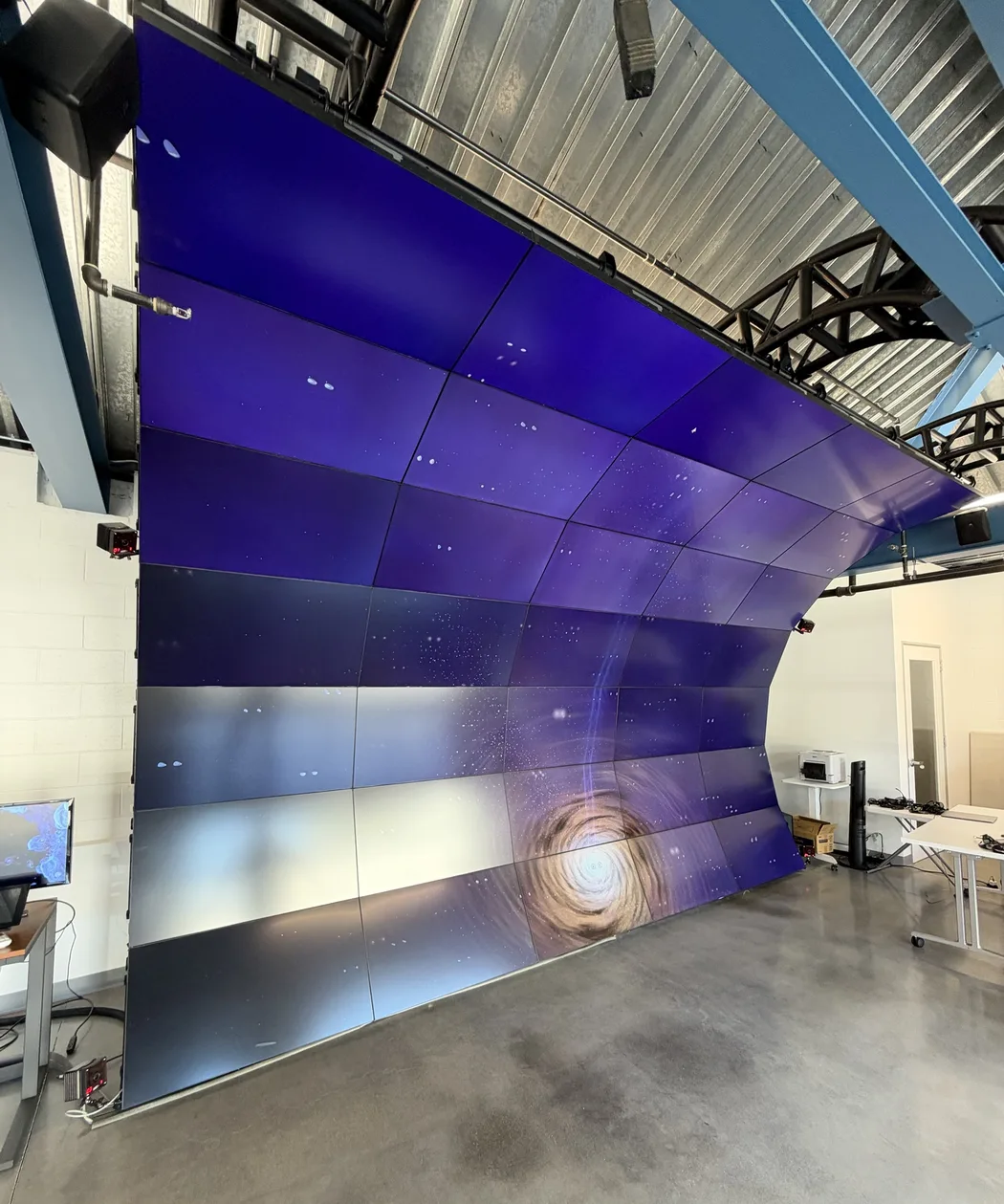
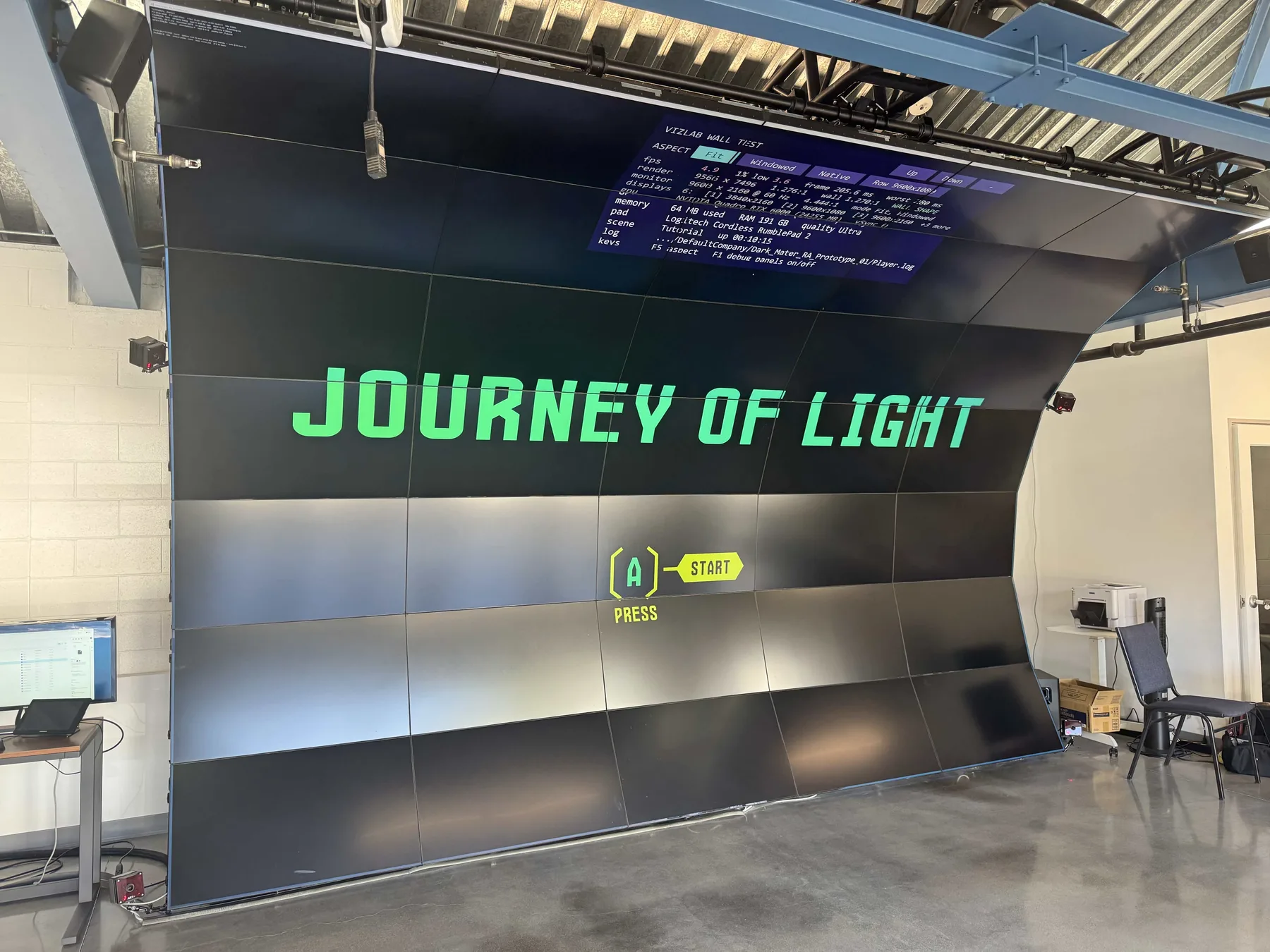
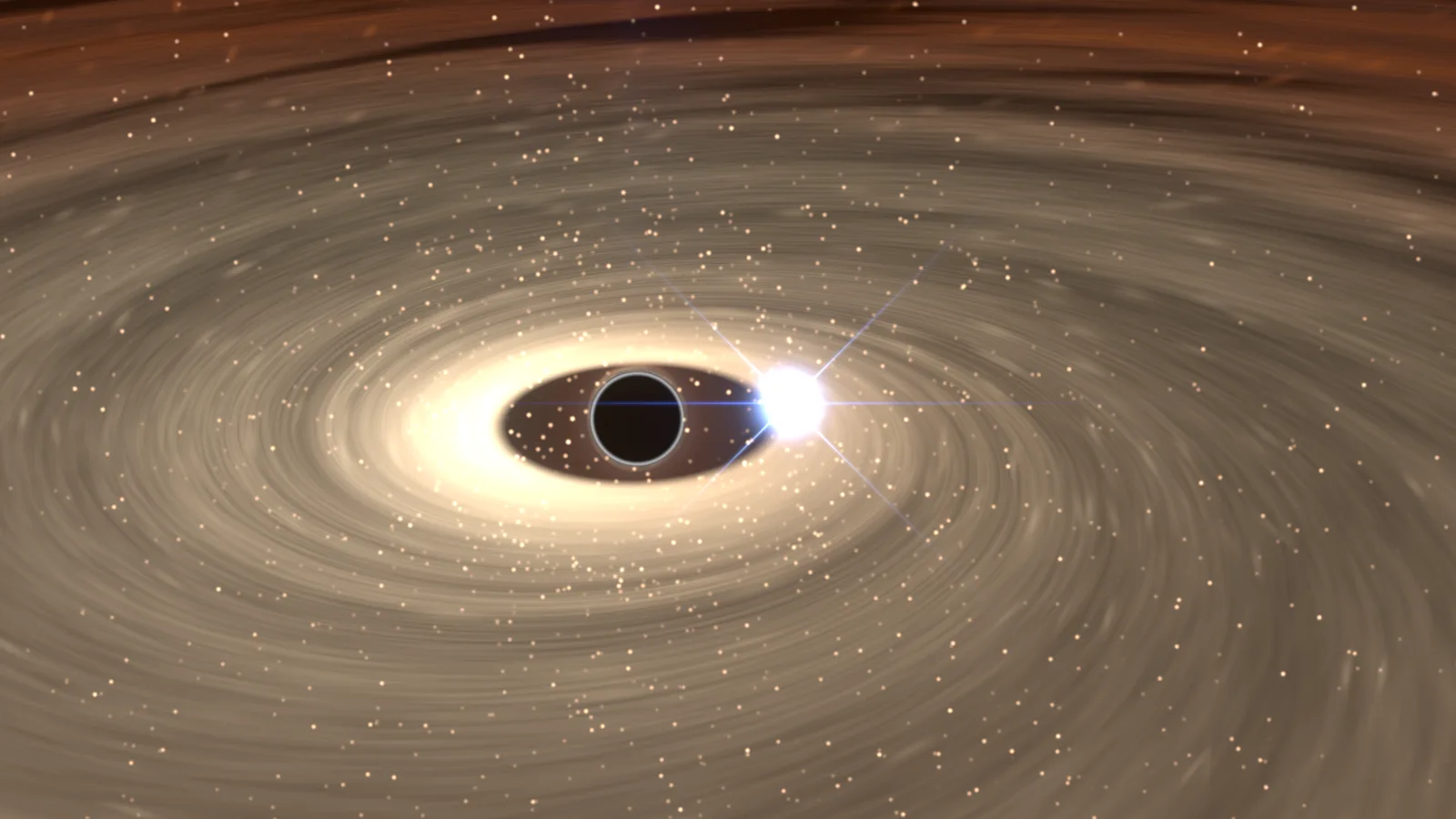
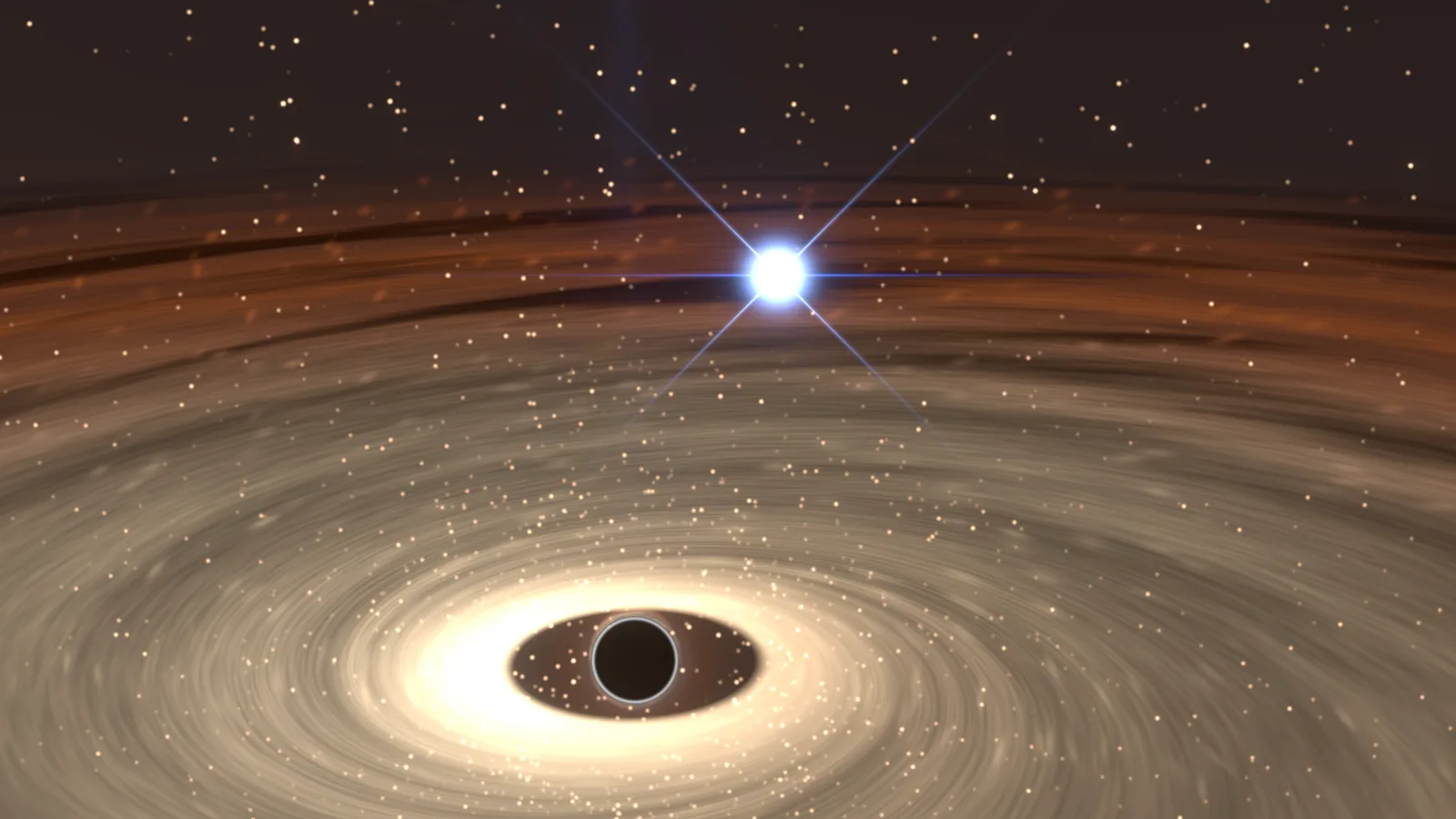
At the quasar. The visitor learns to look, then emits and leaves as its light.
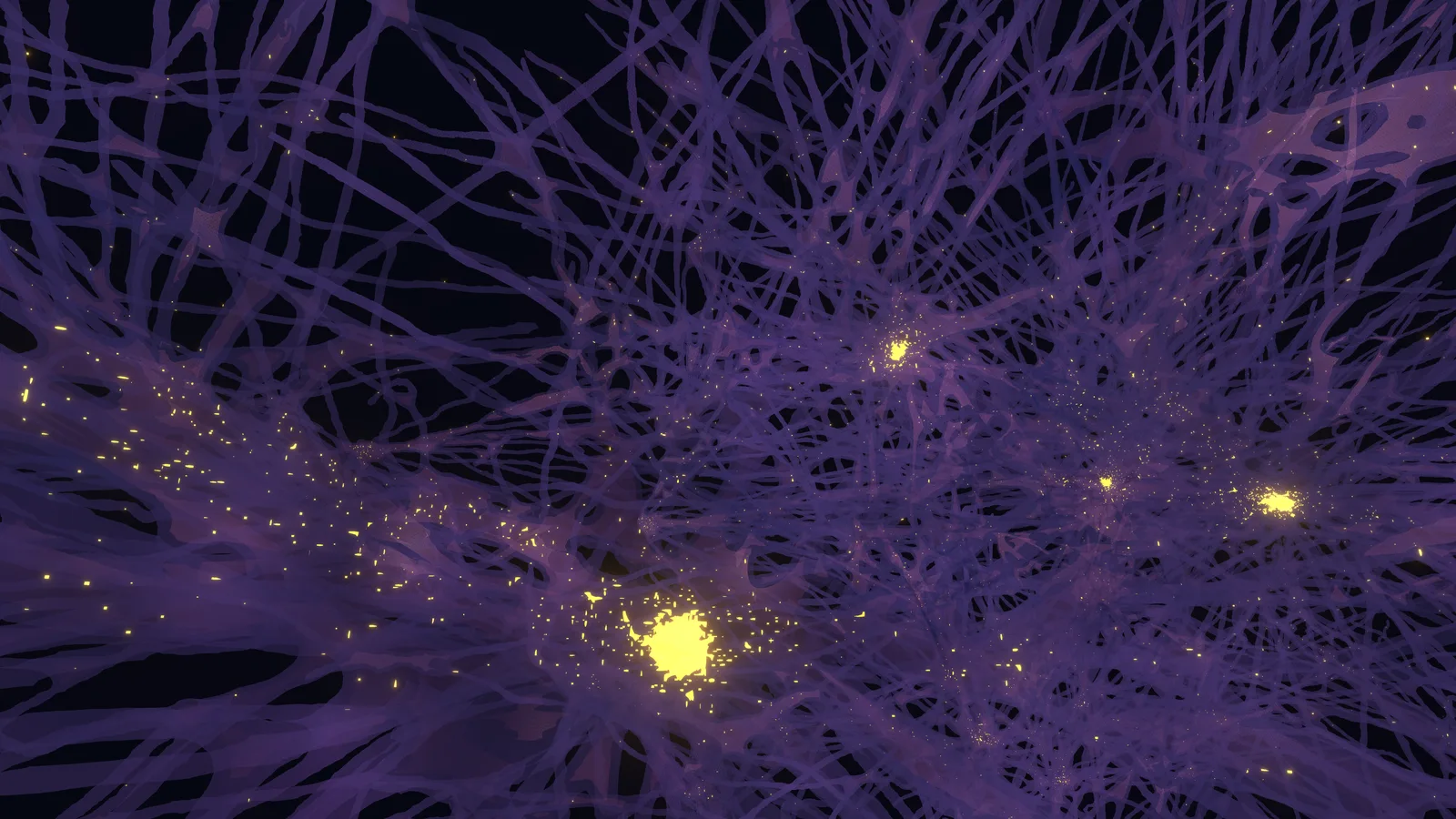
Through the cosmic web. The spectrum at the top gains a dark line each time the light crosses hydrogen.
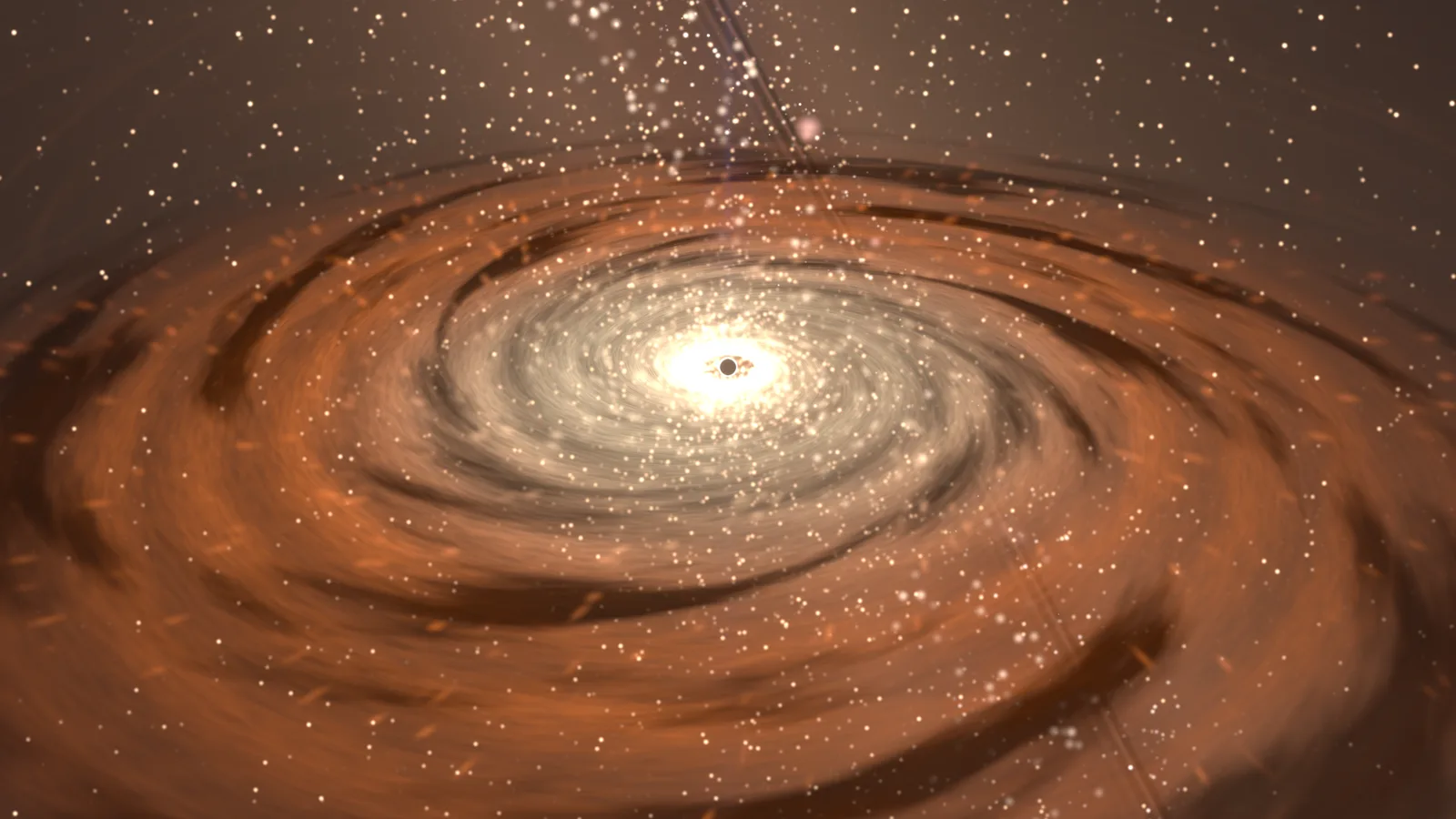
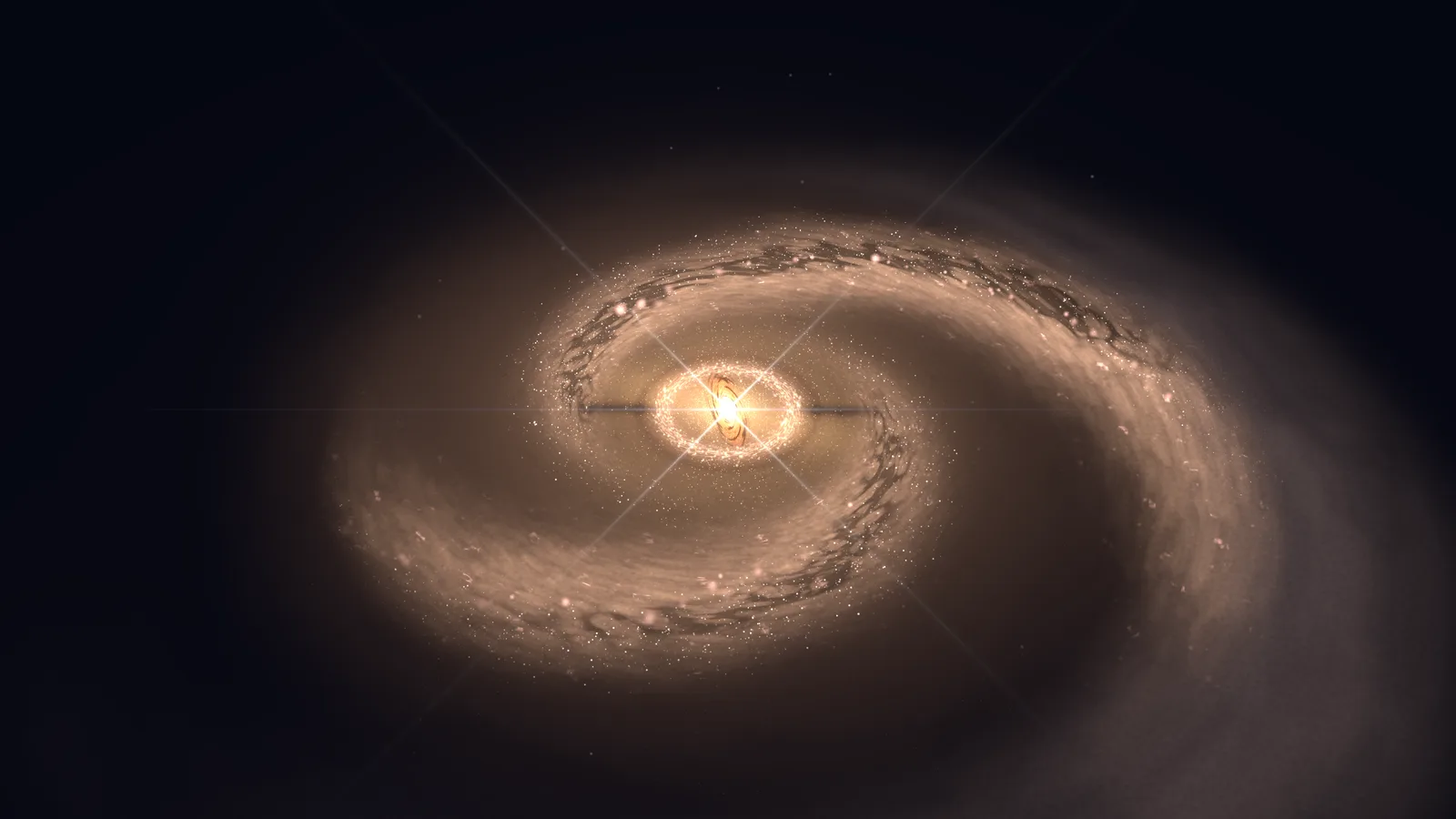
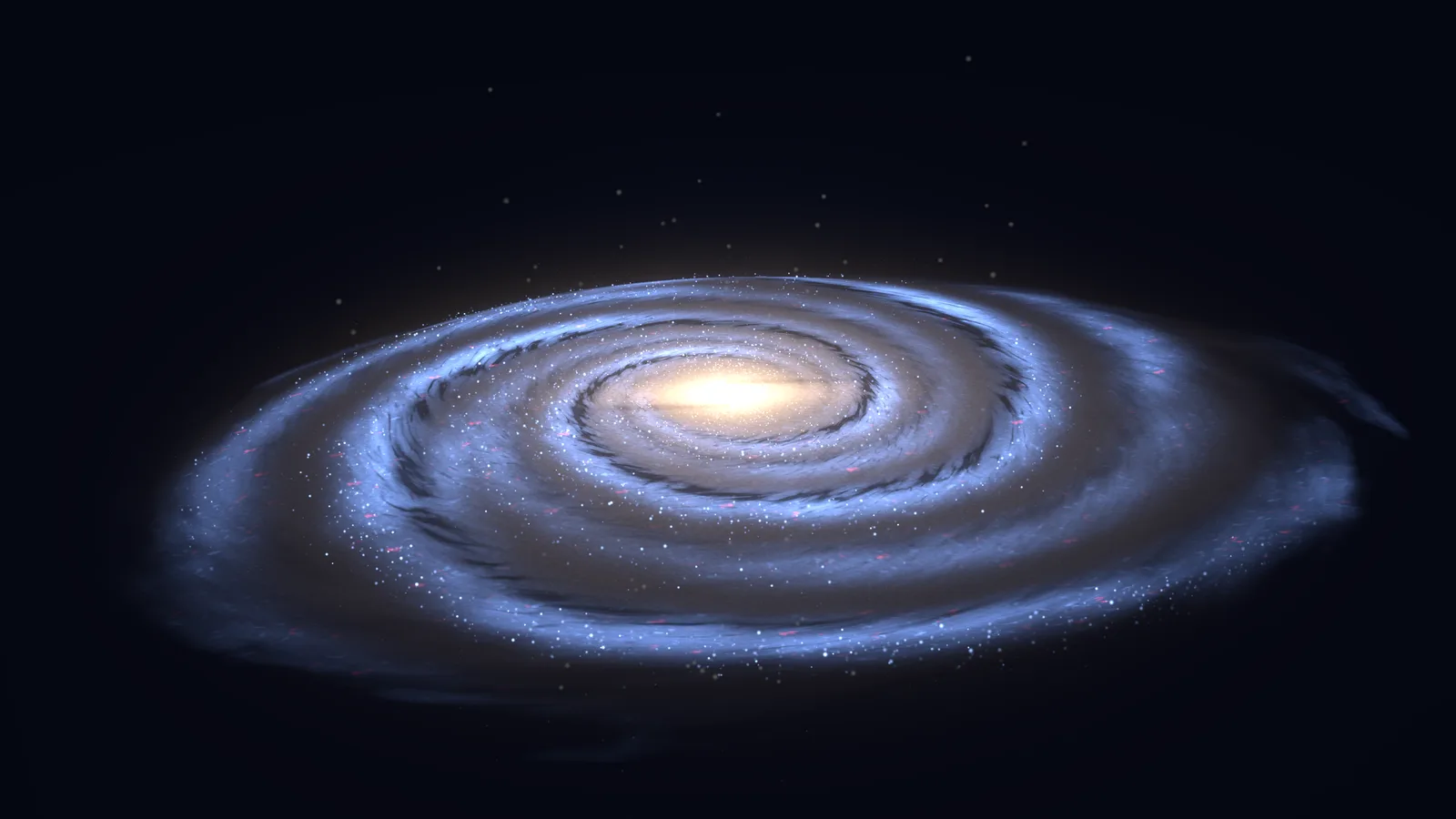
From the Milky Way into the Solar System.
Playtest and Iteration
Dark matter is known only by what it does to things you can see. So the visitor should meet the effect before the cause.
In May 2026 we ran the first playtest in the lab, comparing two builds with a questionnaire, in-game metrics and short interviews. The notes show pop-up text going by too fast, a spectrum graph most could not read, confusion over the camera, and too many new ideas at once. People enjoyed free camera play most, but twelve of twenty players did not fully understand what dark matter is, so they could not tell what the control did.
Designing for the wall
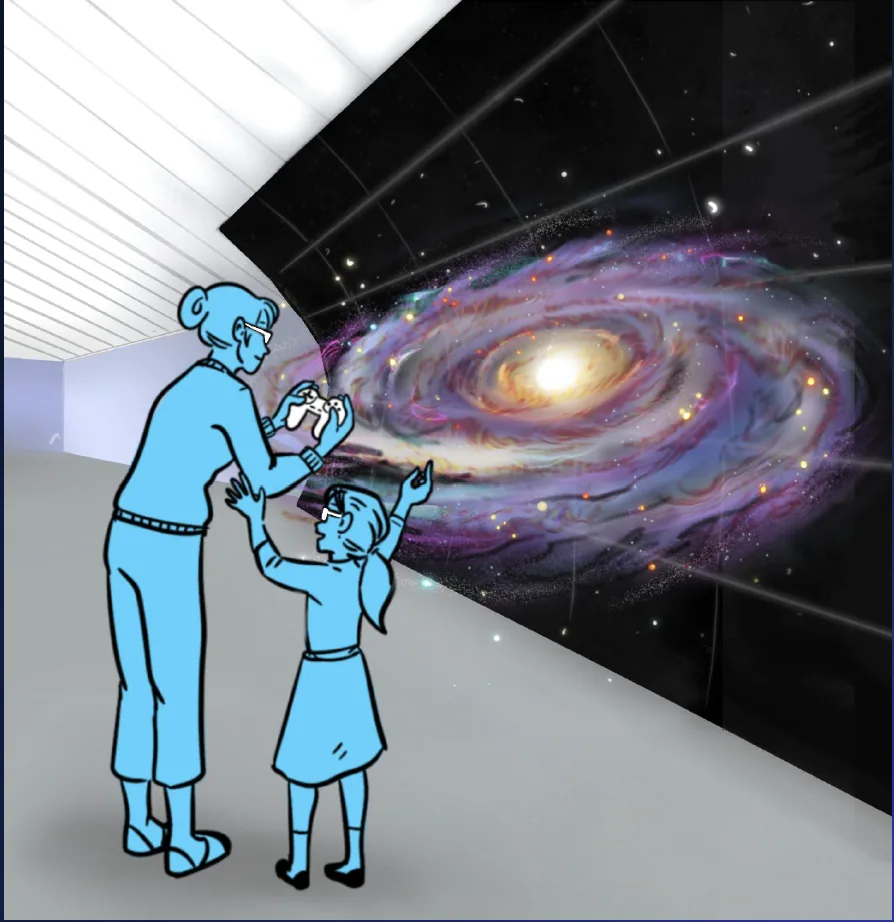
The wall is 35 screens bent from the floor to overhead, seen in 3D glasses by visitors who may never have held a gamepad.
Interfaces laid out on a laptop stretched across the curve. From the lab's calibration data we worked out the wall's shape: only row 5 stands nearly upright, at eye level, so text that stays goes there, everything else is placed in the world, and nothing critical sits overhead, at the floor or across a seam between rows. To design for the wall away from the lab, our technical designer built an overlay that shows the seven rows on the Unity canvas, a component that snaps an element to a chosen row, and test builds that move the spectrum display between rows with the bumpers while it runs. I built tools for the four copies of the build that drive the wall: a probe that logs where they fall out of step, a setting that runs all four on one PC, and a fixed head height for when nobody wears the tracked glasses.
In the hands
The May build handed over both sticks and every button at once. Now there is no move stick, each control is taught when it is first needed, and the controller rumbles when the light hits hydrogen, so an absorption is felt at the moment a line is cut into the spectrum.
May 2026
Handed over at once. People flew around, and lost the direction of travel.
Now
Taught one at a time. The camera follows the light; the visitor looks, zooms and shows the dark matter.
Guiding a walk-up visitor
Nothing advances on a timer. Each step waits for the visitor.
One button with one meaning, from the tutorial to Earth.
Looking stays live through every transition, the emission included.
Hearing an instruction is slower than doing it.
After 90 seconds untouched, it resets for the next visitor.
Building and Optimizing
Try it. Drag the light from the quasar toward Earth.
- Quasar
- Early cosmic web
- A galaxy
- Cosmic web
- Milky Way
- Solar system
- Earth
Shorter wavelengthsLyman-alphaLonger wavelengths
Running on a wall like this makes optimisation and performance one of the project's biggest challenges. The journey runs in real time for about 15 minutes, every frame is drawn for both eyes across 35 screens by four copies of the build kept in step, and the wall's software holds the project to Unity 2019.4. The answer is to pre-bake whatever is costly to compute. The spectrum is calculated in the editor from cosmology and measured hydrogen absorption, and the journey only reads it back; the cosmic web and the gas volumes are made in Houdini and imported; and volumetric gas is drawn for one cluster at a time, with distant clouds as flat images.
In engine
Try it. Click the left or right of the picture to change it, or the middle to see it full screen.
Next
The build reached alpha on the VizLab wall in October 2026 and is refined through regular reviews with the scientists. Next is the second playtest on the new order, then the public installation in Pasadena, with a web-based game that carries the same material beyond the venue and a paper on translating cosmological simulation into a public experience.
Reflection
Getting the science right was the easier part, because the scientists checked every visual. The harder part was the order in which ideas and controls arrive. Twelve of twenty players did not fully understand what dark matter is, so the control meant little to them, even with accurate science on screen. I now design an interactive explanation as a sequence of questions, with each control arriving as the answer to one.
It also taught me to state a simplification rather than hide it, a habit that carries into the archival work, where the same question comes up as what a system shows and what it knows.
LARC encourages using AI tools as part of the research. I learned to use them for quick prototypes, so an idea could be tried before it was built properly. The same work showed me the problems in designs that AI produces.
Technical appendix
The spectrum
The quasar is set at redshift 3.62, the redshift of Q1422+2309, so the light left it about 12 billion years ago, under two billion years after the Big Bang. The light is followed step by step in the editor: emitted with a typical quasar spectrum, stretched by the expansion of space using Planck 2018 cosmology, and absorbed by hydrogen along the path at the measured average rate for each redshift. Every step is stored, and during the experience the display only reads the stored step for the current moment. Some of the inputs are still being checked against the papers they come from.
The curved wall
The large format changes the engineering. Fill rate becomes the main constraint, since every frame is drawn once for each eye, motion that is comfortable on a laptop can cause nausea at scale, and text sized for a monitor cannot be read from where visitors stand. Volumetric gas is costly, so only one cluster of it is drawn as a volume at a time, and distant clouds are drawn as flat images.
Scientific accuracy
The scientists review every visual decision. Typical risks are colour scales that imply a quantity that is not there, particle densities chosen for legibility instead of the model, and time compression that makes structure formation look faster than any physical process. Much of the work is deciding which simplifications are acceptable, and saying so where they are made.