Playing with gesture
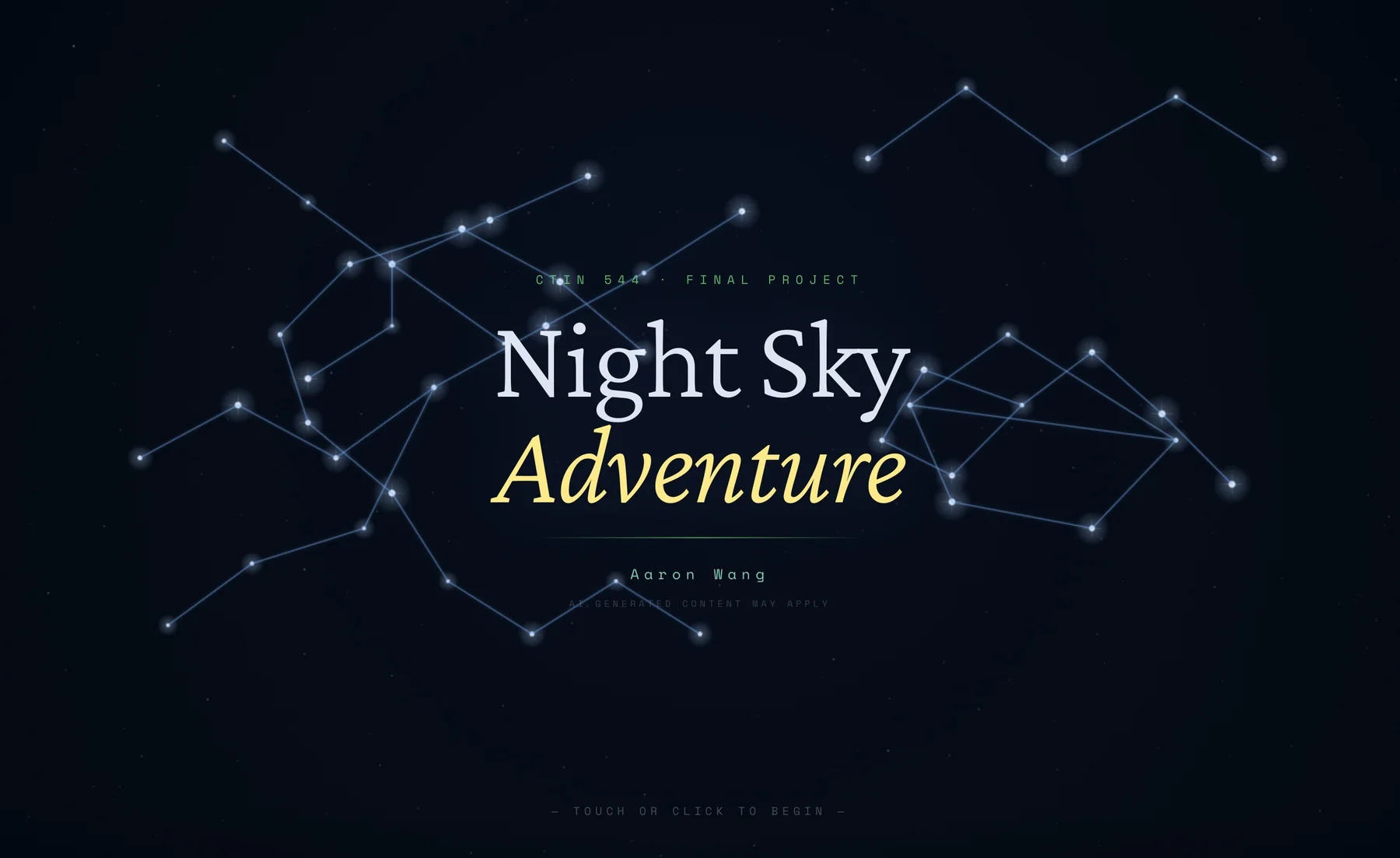
The adaptation keeps the book's central experience, recognising a pattern in the night sky, and builds it around gesture instead of the book's story. Players raise an index finger as a pointer, hold it over a star until a ring fills, and connect the stars into constellation lines.
Pointing at stars is a familiar gesture, so I used it directly as the mechanic. Asking for a hint uses one other gesture, an open palm.
Six constellations are curated as a sequence: Ursa Major, Ursa Minor, Cassiopeia, Draco, Cepheus and Andromeda.
A round
Each constellation is a round against the clock, with more time for the larger ones: 55 seconds for Cassiopeia, 95 for Draco. The player selects a star, then the star it connects to. A correct line stays in the sky. A wrong one flashes and takes five seconds off the clock.
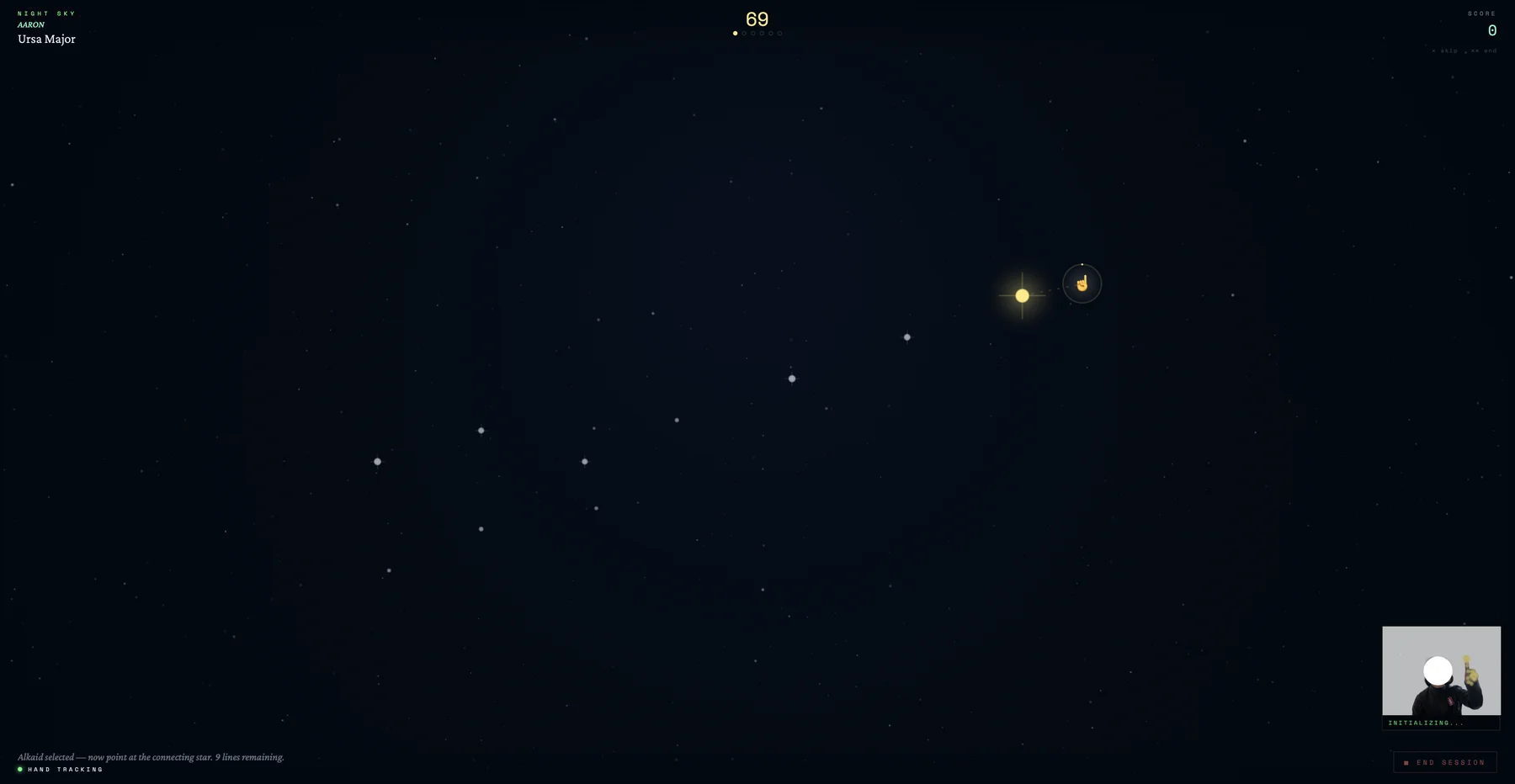
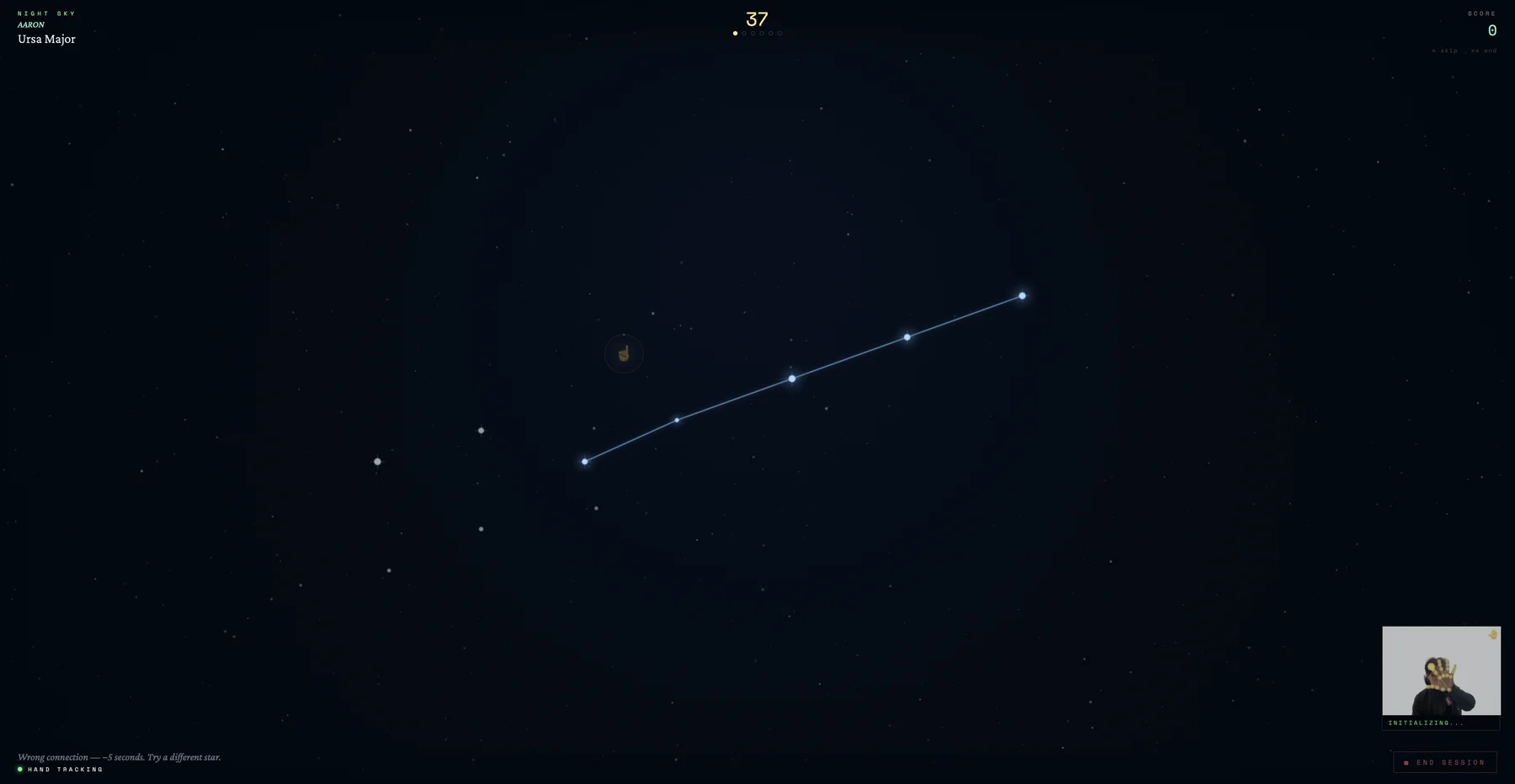
After three wrong connections, an open palm brings up the outline of the constellation and a tip, such as starting from Dubhe and Merak, the two pointer stars of Ursa Major.
Every other control is a gesture or a dwell as well. Crossing two fingers skips a level, crossing both arms ends the session, and the buttons on each screen are chosen by holding a fingertip over them. At the end, the player types a name for the night's leaderboard the same way, one letter at a time.
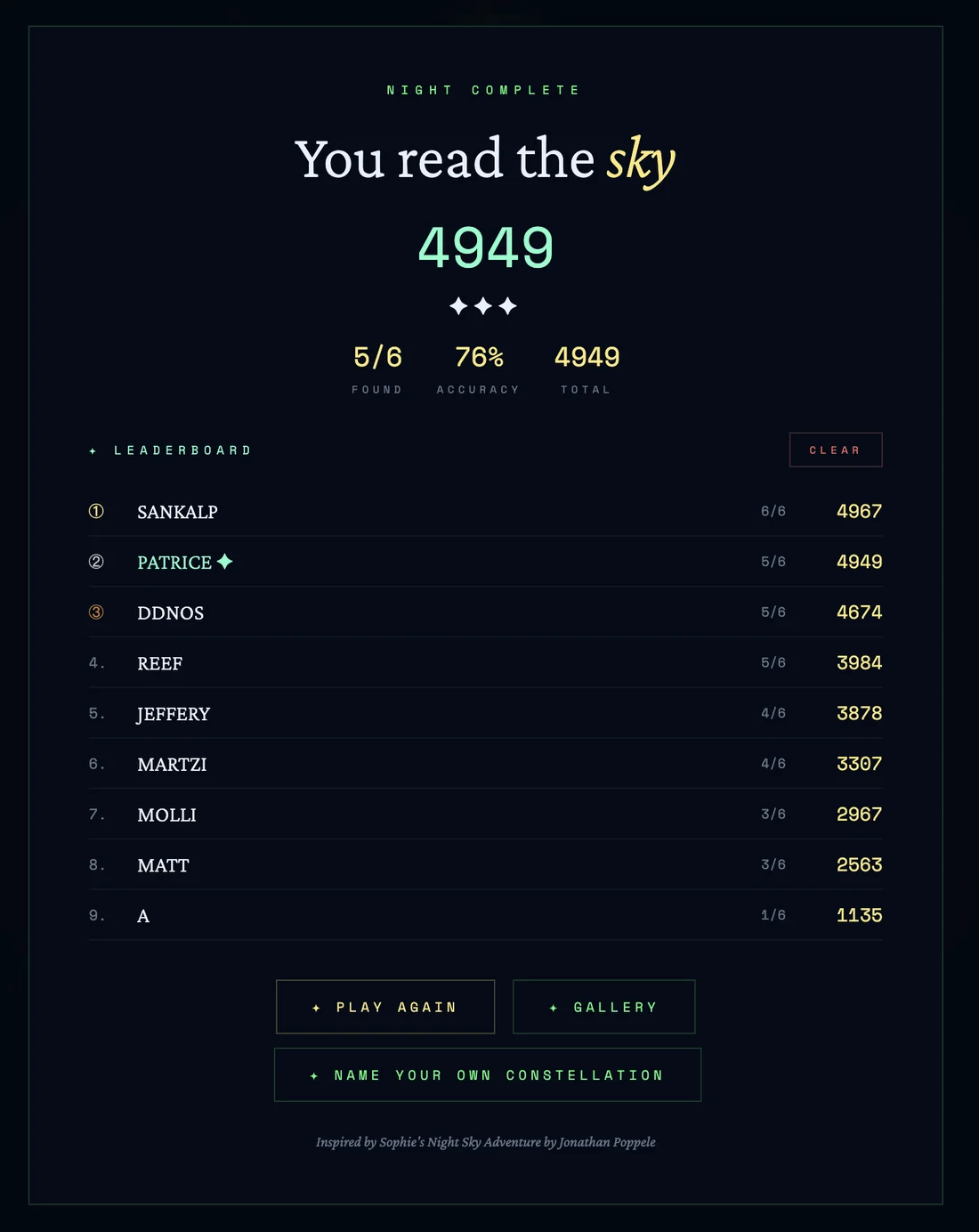
Hand tracking runs in your browser using the camera; nothing is recorded or transmitted. A mouse fallback is built in.
Hand to cursor
The game is played with a hand held up to a camera. Each frame from the camera goes to a hand-tracking model, MediaPipe Hands, which runs in the browser. It finds up to two hands and returns 21 points for each.
PointingThe tip of the index finger, point 8, becomes the cursor.
Open palmFour or more fingertips held above their knuckles ask for a hint.
The game reads only a few of those points. The tip of the index finger becomes the cursor, flipped left to right so that it moves the way a person expects when facing the screen. To tell an open palm from a pointing hand, the game checks whether each fingertip sits above its knuckle.
Frame to star
The raw fingertip shakes a little from frame to frame, even when the hand is held still. The cursor follows a smoothed copy, moving 15 per cent of the remaining distance each frame, so it stays put when the hand does.
There is no click. Within reach of a star, a ring fills over 0.9 seconds and the star is selected when it closes. Moving away resets the ring, and a star cannot be selected again until the cursor has left it.
Try it with a mouse. Hold the pointer still on a star until its ring fills, then move to the next.
A shared sky
After finishing the curated sequence, a player can draw their own constellation, name it, and leave it in the game.
The drawings are saved to a shared gallery that builds up across sessions and visitors, so the sky shows the shapes drawn by everyone who played before.
VR adaptation
The current version uses a screen and a camera. The next step is an adaptation for a VR headset.
Reflection
I started from the gesture: pointing is what people already do when they show someone a star, so the mechanic needed no teaching. The work went into the moment after the pointing. Holding still became the real interaction, and its length decided whether the game felt like attention or like waiting.
That changed how I think about bodily input. The body brings the meaning of a gesture with it; what the design decides is its timing, and what the screen gives back while the player waits.
Technical appendix: hand tracking, dwell, and the shared sky
Hand tracking in detail
MediaPipe Hands returns normalised landmark coordinates; the game uses landmark 8, mirrors its x axis and maps it to the screen, then smooths it with an exponential filter. The star hit radius is 42 pixels in play and 60 when drawing a constellation of your own. An open palm is detected when at least four fingertips are higher than their knuckles; while it is open the cursor dims and dwell is paused.
Constellations
Six are curated as a sequence: Ursa Major, Ursa Minor, Cassiopeia, Draco, Cepheus and Andromeda. Each is a list of star positions and the edges between them. Lines are drawn only between stars the player has actually connected, in order, so a half-finished constellation looks half-finished and does not act as a hint.
The shared gallery
Free drawing writes a normalised point list, a name and a timestamp to persistent storage, keyed so that new entries are added without overwriting old ones. On load the gallery reads back every earlier entry, so later visitors see more shapes than earlier ones. Nothing about a person is stored except the shape they drew.
Fallbacks
If the camera fails, is refused or is unavailable, a mouse fallback takes over with the same dwell logic, so the piece still works, more slowly, instead of showing an error.