About
A physics adventure for children aged 6 to 10. Golf, an orange ball, crosses handmade levels to reach his friend Orb. The objects stretch, bounce and deform instead of behaving like rigid bodies, and each level works as a small physics playground. The style is 3D rendered as 2D.
Original / no internet assets applies to the core algorithms, assets, interactions and models, all self-developed. It does not cover music or skybox materials.
The question
Under the same input and in the same levels, does a ball that deforms change the player's sense of agency, compared with a rigid one?
This artefact is the practical half of my UCL dissertation (2025), since revised as How Can Soft-Body Physics Simulation Influence Players' Agency in Digital Games. Agency here is the fit between what a player wants to do and what the system can register. It shows up as an intention formed before a shot, an outcome the player attributes to their own action, and a next shot adjusted in the light of what happened. A second question follows: when do players turn what the deformation shows them into knowledge they use on the next shot?
The method is practice-based, and in HCI terms research through design: writing and tuning the solver was part of the inquiry. The analysis draws on affordance theory and on the Mechanics-Dynamics-Aesthetics framework.
Rigid body: controllability
Agency through precision and repetition, as in Angry Birds.
Soft body: explorability
Agency through trying, and reading how the ball deformed.
The solver
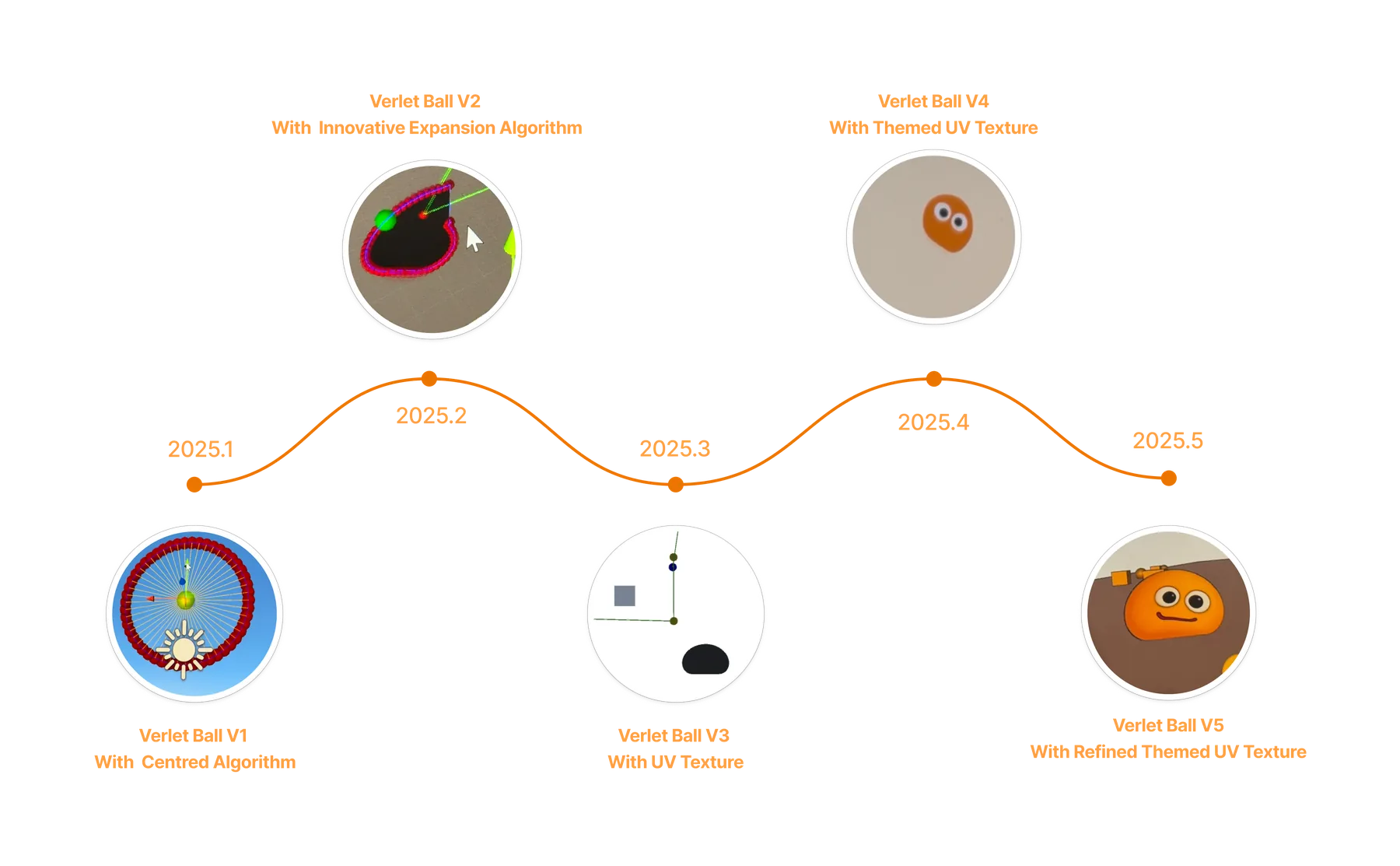
Explicit Euler, the simplest integrator, adds a little energy to a spring at every step until the body comes apart. Verlet keeps each point's current and previous position and takes the velocity from the two, so the energy cannot grow, and the game can move points directly to hold Golf together.
In the final build Golf is a ring of 50 particles. Each fixed update runs four sub-steps, and more when a particle would move further in one step than the collision threshold, so fast shots do not pass through thin walls. Each sub-step runs 20 constraint iterations. A pressure term compares the ring's area with its rest area and pushes each particle outward in proportion to the shortfall; this is what makes the ball squash and recover. A collision with a drawn edge corrects a tenth of the overlap per iteration, so some deformation survives the contact.
Try it. Drag a point on either ball, and the same point moves in both.
Explicit Euler
Verlet
Play
Drag back
Golf stretches under the pull. The longer the line, the stronger the shot.
Aim
An arrow shows the direction and power of the shot.
Release
Golf rebounds into flight and squashes on impact.
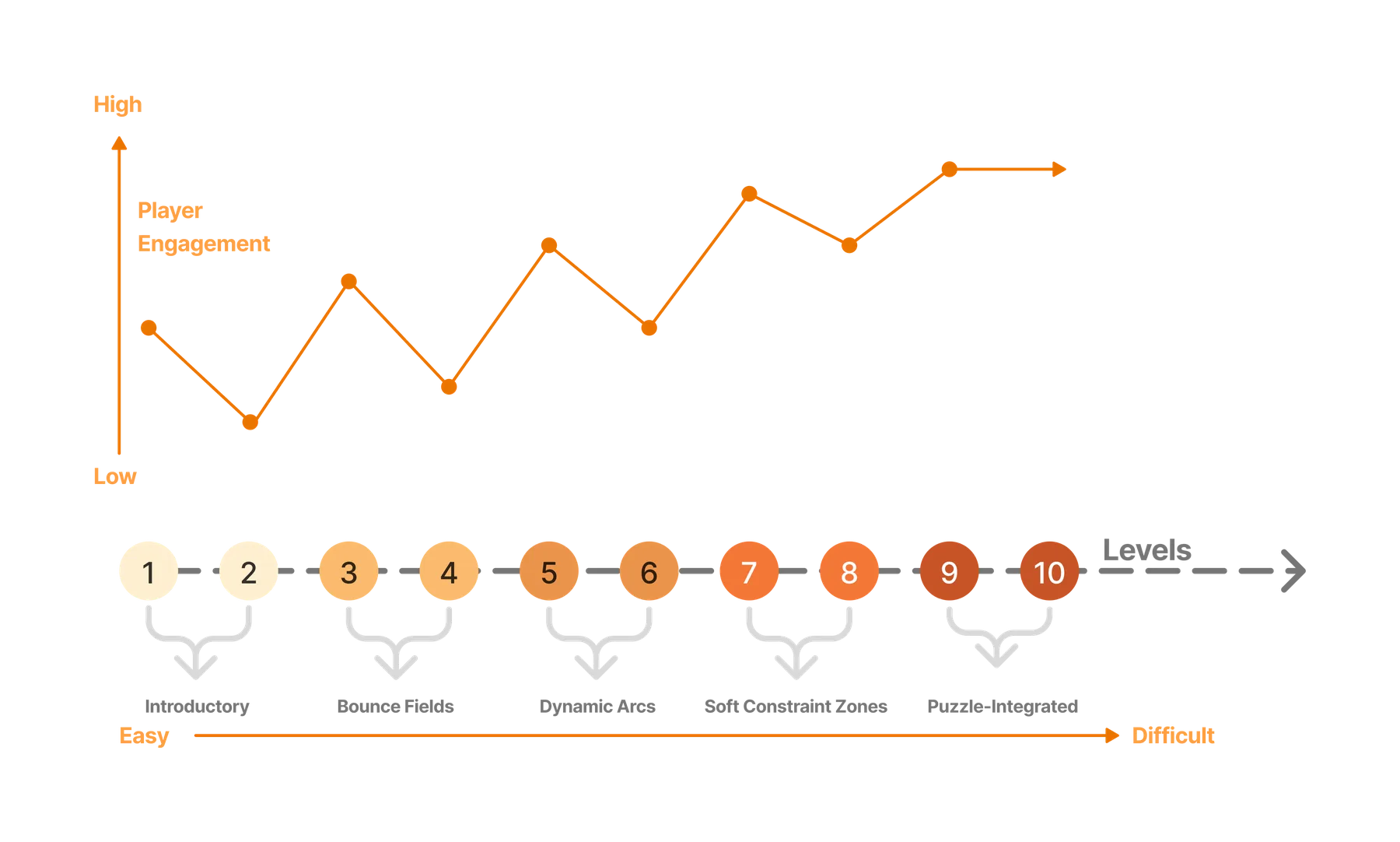
There is no text in the levels. The world is built from rounded shapes to match the elastic physics, in warm oranges and creams, with orange Golf and black Orb kept in contrast. Collision sounds make the physics easier to read, and the music changes a little from level to level.
Playtests
During development, alpha playtests with players in the target age range looked at how they understood soft-body motion and led to interaction changes. Beta widened the audience and brought the bigger changes: new level layouts, the reworked launch, and fixes to bugs that broke the flow.
What the development playtests found
- The ball read as alive. Players called the impact satisfying and the ball alive or reactive.
- Strategy came from experiment. They adjusted angle and timing by trial, reading how the ball answered.
- Openness brought ambiguity. Some could not tell what was interactive.
Soft ball against rigid ball
A within-subject playtest then compared the soft ball with a rigid ball, under the same input and in the same levels, with 7 adults. After a practice level, each played three test levels (a direct shot, a bounce and a moving bar) once with each ball. Four started with the soft ball and three with the rigid one. Each level had a three-minute limit, and players thought aloud. The rigid ball was a Unity Rigidbody2D circle with the same radius, texture and launcher.
Evidence came from behaviour, self-reports and what players said. The self-reports used adapted, unvalidated agency items and five Player Experience Inventory subscales. A changed shot did not count as agency by itself; a player's stated link between an outcome and the next intention did.
- No consistent agency advantage. The soft ball was rated 0.33 lower on the adapted agency items (7-point scale), and 0.52 higher on autonomy and 0.38 higher on curiosity. The agency differences changed direction between the two order groups.
- More surprising, still their own. Players rated the soft ball as more surprising, yet rated where it ended up as slightly more their own doing.
- Similar completion. 17 of 21 test levels were cleared with the soft ball and 18 with the rigid ball, over 104 and 95 attempts. The only difference was the bounce level, 6 of 7 against 7 of 7.
From outcome to next shot
On the soft-ball bounce level, players often explained a result by where and at what angle the ball hit. For two of them this became the basis of the next shot: "it pressed on this side and went long, so pull less next time". Unexpected rebounds could also upset a plan; two players who tried to keep to a planned route found them "hard to match to my original plan". Two players adjusted the same way with both balls, so some of this is general learning rather than deformation.
Could improve
- Collision had no rotation or compound shapes, which limited the puzzles.
- The difficulty step between levels 4 and 6 was too steep.
- The story was thin.
- The ball's stiffness depends on the number of iterations and the time step, not on a material constant.
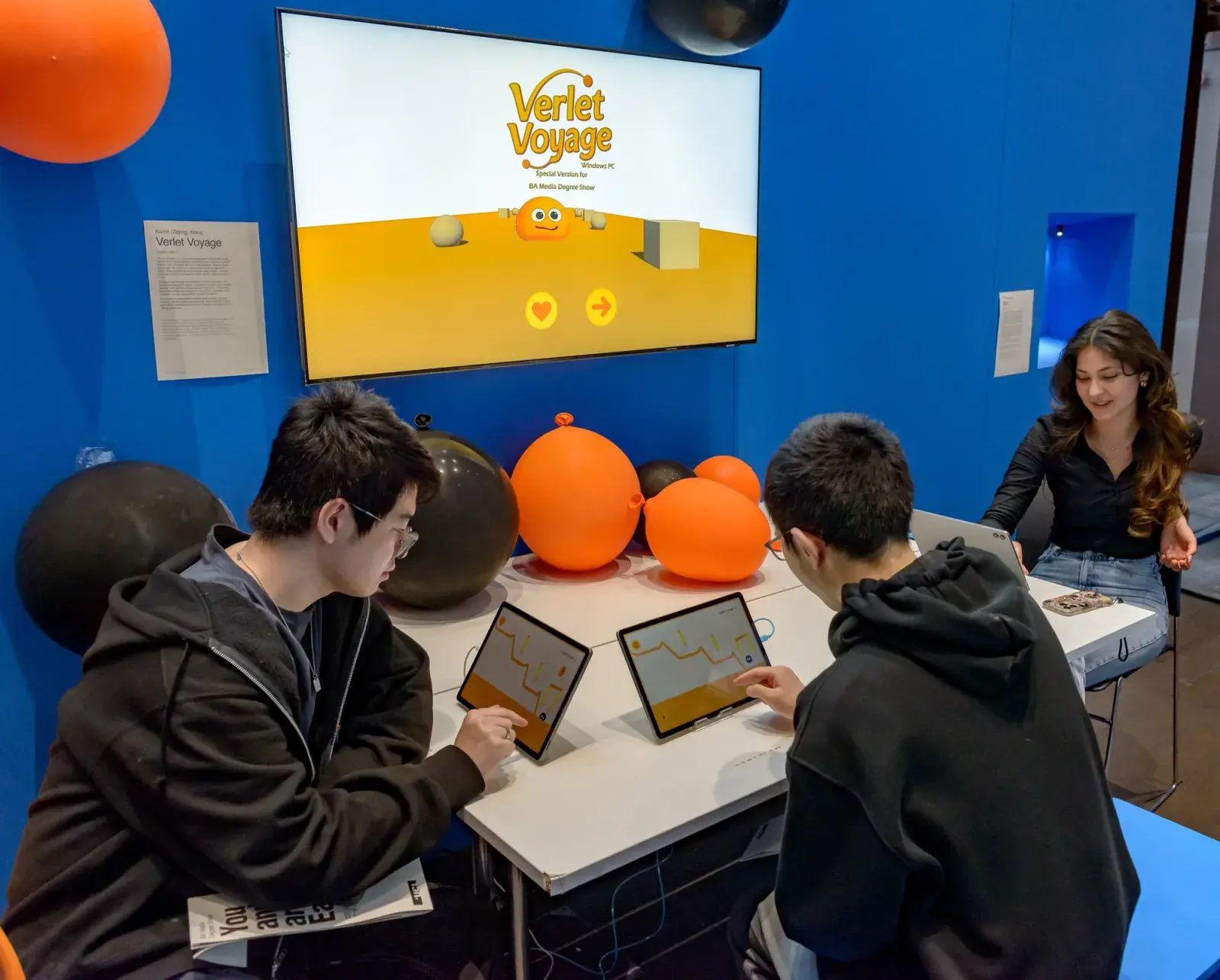
Degree show
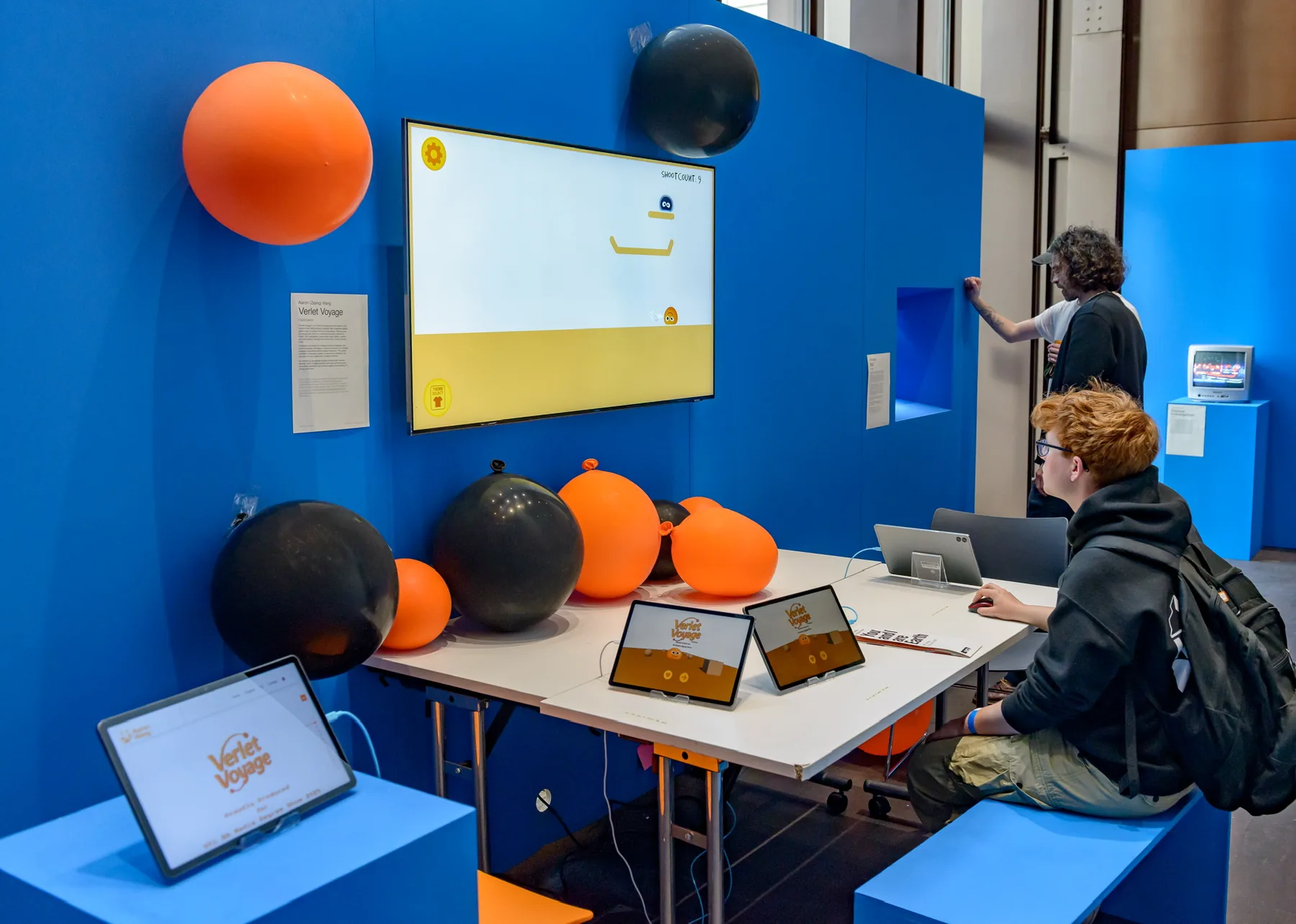
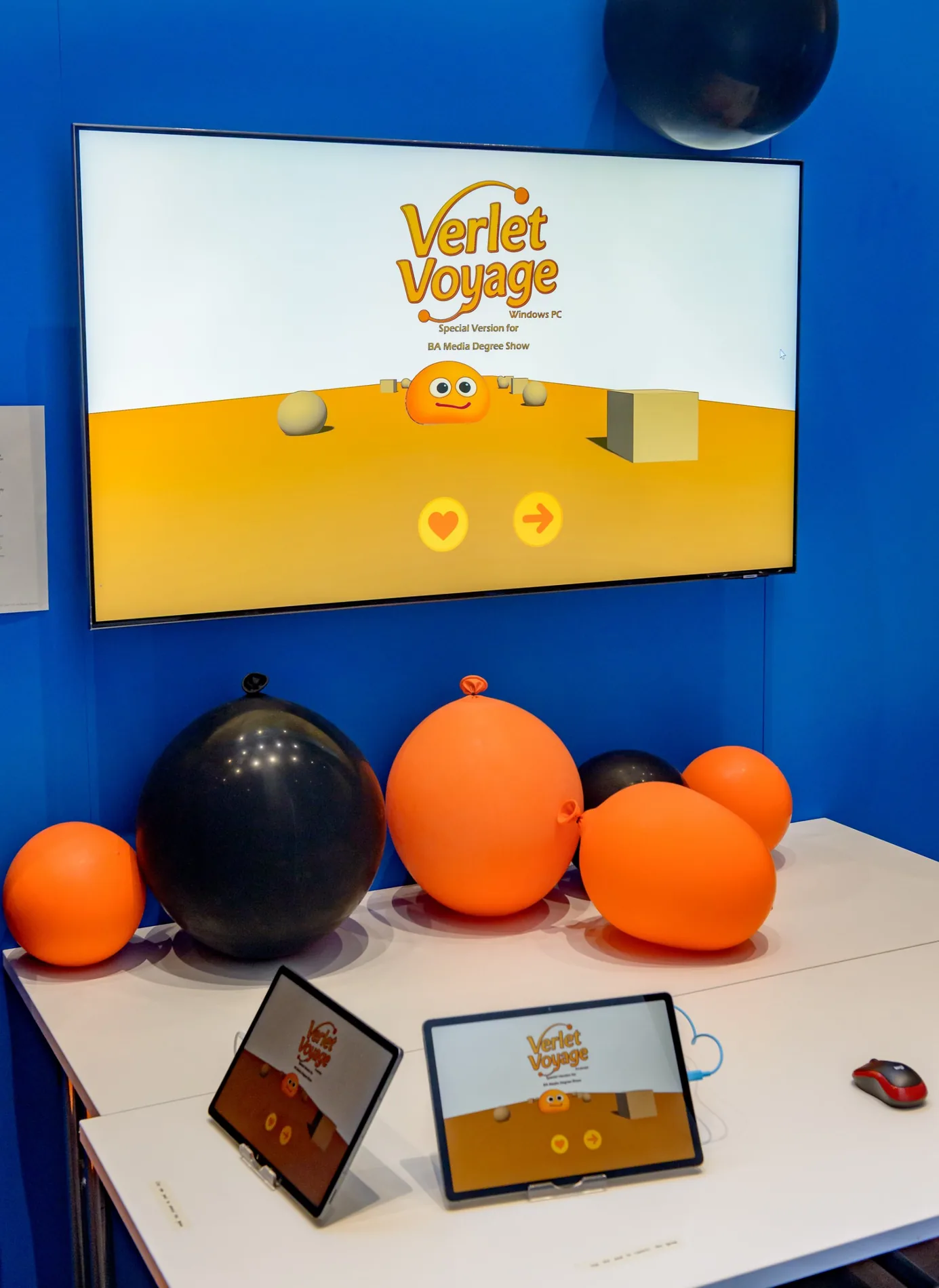


Technical appendix: the solver, the level editor, the shaders
The core system
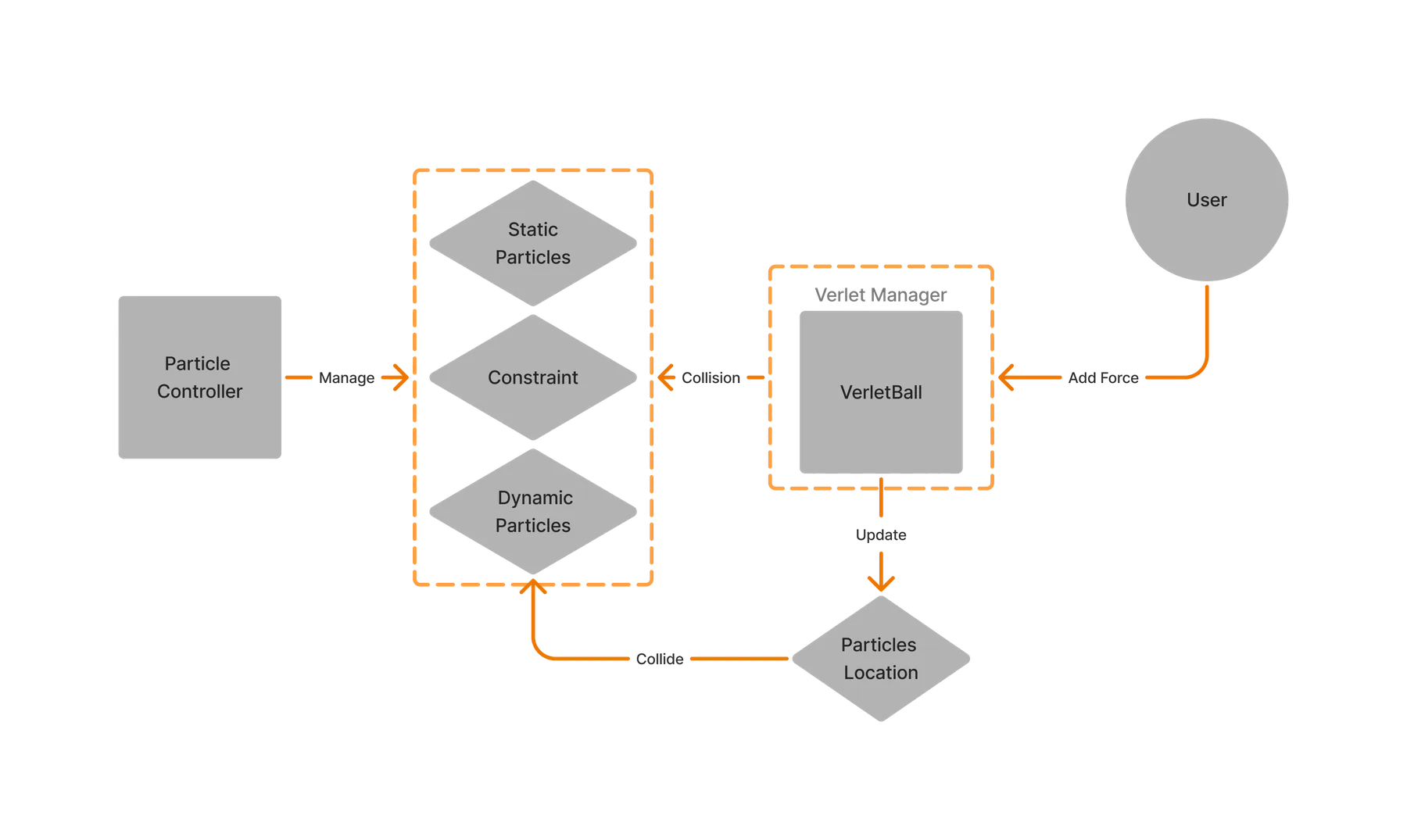
The simulation loop: on release, every particle of the ball receives an impulse. The VerletBall updates through integration and constraint solving. Collisions resolve against particles and constraints. Particle positions update. The loop runs until the ball stops moving.
- Ball constraint: fixed-length constraints and custom elastic behaviours preserve shape and volume.
- Inflate constraint: compares the ring's enclosed area with its rest area and pushes particles outward along their normals, so the ball keeps its volume under load.
- Sub-steps and iterations: four sub-steps per fixed update, raised for fast shots, and 20 constraint iterations per sub-step, solved in alternating order so that no direction is favoured.
- Mesh: a UV-mapped triangle fan, rebuilt from the particle positions every frame.
- Collision: ground collision, edge collision against static geometry, and dynamic collision against moving objects.
The environment is built from static particles (walls, pins), dynamic particles that can be pushed, and constraints that define spring-like relationships between them. Anti-gravity zones and directional forces add movement that is deliberately not realistic.
A custom level editor
Tilemaps and prefab composition are not enough for a physics-driven world, so I built an editor into the ParticleController component that draws collision environments directly in the Scene view.
- Key modifiers place geometry: S adds a static particle used as a wall or anchor, A adds a dynamic particle and connects it to the last static one, W adds a standalone static particle.
- Clicking two existing particles connects them with a constraint; constraint type, thickness, colour and material are configurable per type.
- A constraint creation mode lets designers define relationships by hand for composite or maze-like structures.
- Levels serialise positions, static/dynamic state and constraint data to JSON-like structures for reuse, with loading deliberately delayed so physics and rendering are ready before instantiation.
Shaders and effects
An edge shader accentuates object boundaries so soft, toylike assets stay crisp and readable. Luminance from neighbouring pixels is evaluated with a Sobel operator for horizontal and vertical gradients, combined into edge intensity, then blended with object colour. The result is a smooth, clear outline that makes objects easier for younger players to read. A confetti particle system with randomised colours and directional bursts rewards level completion.
Reflection
What this changed in my understanding
The study suggests that a soft body may change how players reach agency more than how much of it they feel. The playtest is consistent with this: the soft ball was rated higher on autonomy and curiosity, not on perceived agency. Surprise, understanding and a sense of authorship did not always come together. Deformation appears only after contact, so it first explains a result, and it helps only when the player carries it into the next shot. I now look for that step, from what a system shows to what a person does next, in the archival agents as well.
Thanks to William Sykes and Dane Sutherland at UCL.